Reconciling people with the forest, wherever it is at stake.
ONF International works to preserve and restore the world’s forests, with one conviction in mind: the sustainable management of forest ecosystems is vital for the climate, biodiversity and the communities that depend on them.
We work alongside governments, indigenous peoples, public and private players, in a process of co-construction, local anchoring and sustainable solutions.
Because a well-managed forest holds the promise of a livable future, we place our public expertise at the service of the global forest commons.
Here, the forest speaks. And we listen..
ONF International
The RESCCUE project was launched to strengthen the resilience of Pacific island territories to climate change through integrated and sustainable coastal zone management.
Oceanian island states and territories are among those most exposed to sea level rise, erosion, soil salinisation and increasing pressure on natural resources. These developments are undermining coastal ecosystems, infrastructure and the livelihoods of local populations.
In this context, RESCCUE supports adaptation to climate change through integrated coastal zone management (ICZM), in particular by mobilising economic analysis and financial mechanisms to support sustainable, effective and long-term actions.
Activities carried out
As part of the RESCCUE project in the Northern Province, coordinated and implemented by ONFI, several major actions have been carried out:

Establishment of a hydrological, meteorological and erosion monitoring system (HME), accompanied by its operationalisation in the field.
Development and implementation of hunting and regulation actions in a drinking water catchment basin in Tuo Cèmuhî (Touho), in partnership with the TIPWOTO hunting association.
Implementation of ecological restoration actions with a collective of members of the Pwö-i (Poyes) and Tiwae tribes in the same watershed.
Conducting economic analyses of ecosystem services, including assessing their evolution under different management scenarios.
Identification and support of local financing mechanisms, in support of the World Heritage associations of Pum (Poum) and Pwêêdi Wiimîâ (Poindimié).
Conducting a legal, institutional and economic study on the prospects for promoting venison.
The project in figures
Tools
1 Complete HME system (hydrology, meteorology, erosion) installed and operational
Actions
3 Key actions: environmental monitoring, invasive species control, restoration
Training
Capacity building for young hunters and implementation of regulatory measures
Project details
More specifically, the project aims to:
Preserve and enhance the functionality of coastal ecosystems by developing operational models for integrated coastal zone management (ICZM).
Consolidate the capacities of regional and local administrations by fully involving them in a multi-stakeholder consultation process, which is a central element of ICZM.
Promote the integration of recommendations, tools and economic analyses into public policy by demonstrating to decision-makers the relevance and operationality of the proposed economic instruments.
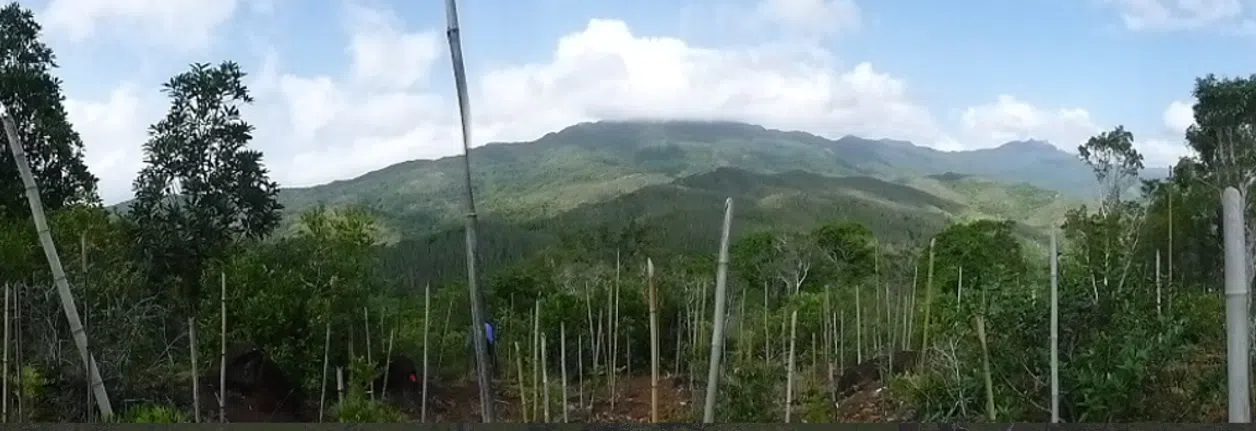
Illustrative image depicting local communities involved in field activities in the Northern Province
The main phases of the project
1
Strategic framing and initial ICZM diagnosis (mid-2015 – early 2016)
2
Implementation of monitoring mechanisms and baseline studies (2016)
3
Implementation of ICZM field operations (2016–2017)
4
Innovative economic and financial mechanisms (2017)
5
Capitalisation, policy integration and closure (early 2018 – 31 July 2018)
Expected results
A fully operational hydrological, meteorological and erosion (HME) system has been set up, accompanied by a long-term research programme led by ONFI (CIFRE PN 2018–2021) in partnership with the Northern Province, IRD and UNC. Two new research projects have also been funded as part of this initiative.
Greater mobilisation of local communities, particularly among the Pwö-i (Poyes) and Tiwae tribes, with the creation of restoration plantations in the drinking water catchment area (2016–2017). A decrease in the number of fires has been observed locally, and actions are continuing beyond the project.
Increased structuring of the TIPWOTO hunting association, including training for young hunters and the implementation of measures to control invasive large game.
Experimentation with local financing mechanisms that promote ecosystem services, particularly through a project to promote the invasive Pinus species.
Progress has been made in promoting the meat of hunted deer, an invasive species: the project has highlighted the value of a legal framework for this practice, both to exploit increased harvesting potential (+25%) and to use it as a lever for financing the management of the sector.
The emergence of new concepts of territorial management and ICZM, integrating the restoration of biodiversity and the enhancement of terrestrial ecosystem services and customary lands. This work has led to the financing of a new project by the French Agency for Biodiversity in the Northern Province.
Budget
341 000 €
Partners
ONF RTM (hydraulic engineering expert); Bioeko and Vertigo lab
Beneficiaries
Pacific SPC; Public institutions in the Northern Province; Local communities and partner tribes; Local associations; Stakeholders in the hunting industry
The Fazenda São Nicolau is an emblematic forest restoration and sustainable management project developed by ONF International in the state of Mato Grosso, Brazil, since 1999.
Caminemos Territorios Sostenibles - Integrated rural development for peace in Guaviare
The TerrAmaz project works to sustainably improve living conditions in rural areas of the department of Guaviare through integrated territorial management and strengthened essential services.
ONF International uses cookies to personalize content and provide you with a tailored experience. You can manage your preferences and learn more by clicking “Cookie Settings” and learn more about Personal Data.
This website uses cookies to enhance your experience when browsing the site. Of these cookies, those considered necessary are stored on your browser, as they are essential to the basic operation of the website. We also use third-party cookies to help us analyze and understand how you use this website. These cookies will only be stored in your browser with your consent. You also have the option of refusing these cookies. However, deactivating some of these cookies may have an effect on your browsing experience.
Necessary cookies are absolutely essential for the website to function properly. These cookies ensure basic functionalities and security features of the website, anonymously.
Cookie
Duration
Description
cookielawinfo-checkbox-analytics
11 months
This cookie is set by GDPR Cookie Consent plugin. The cookie is used to store the user consent for the cookies in the category "Analytics".
cookielawinfo-checkbox-functional
11 months
The cookie is set by GDPR cookie consent to record the user consent for the cookies in the category "Functional".
cookielawinfo-checkbox-necessary
11 months
This cookie is set by GDPR Cookie Consent plugin. The cookies is used to store the user consent for the cookies in the category "Necessary".
cookielawinfo-checkbox-others
11 months
This cookie is set by GDPR Cookie Consent plugin. The cookie is used to store the user consent for the cookies in the category "Other.
cookielawinfo-checkbox-performance
11 months
This cookie is set by GDPR Cookie Consent plugin. The cookie is used to store the user consent for the cookies in the category "Performance".
viewed_cookie_policy
11 months
The cookie is set by the GDPR Cookie Consent plugin and is used to store whether or not user has consented to the use of cookies. It does not store any personal data.
Functional cookies help to perform certain functionalities like sharing the content of the website on social media platforms, collect feedbacks, and other third-party features.
Performance cookies are used to understand and analyze the key performance indexes of the website which helps in delivering a better user experience for the visitors.
Analytical cookies are used to understand how visitors interact with the website. These cookies help provide information on metrics the number of visitors, bounce rate, traffic source, etc.
Advertisement cookies are used to provide visitors with relevant ads and marketing campaigns. These cookies track visitors across websites and collect information to provide customized ads.